Posts

Image
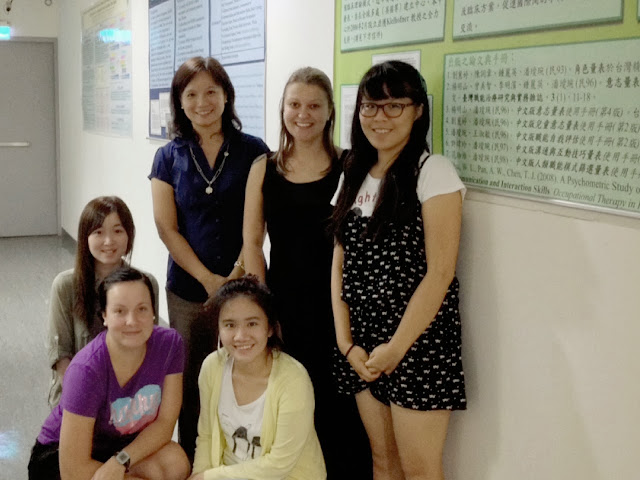
MOHO center in Taiwan visitors- from JAMK University of Finland and from School of Occupational Therapy of National Taiwan University Students from JAMK University Students from OT of NTU
The new research results of Volitional Questionnaire (traditional Chinese version)- Inter-rater reliability for persons with mental illness Title:  The Inter-rater Reliability of  the   Volitional   Questionnaire -   Chinese Version(VQ-C) Author: Wei-Ann Chen Major Finding: The Study confirmed that the Chinese version of VQ has acceptable inter-rater reliability. Participants: N=100 subjects, 3 licensed OT who were trained to use VQ • 59 males,41females • Mean age of the subjects: 47.8 years (SD=12.6) • Diagnosis Condition: 37 subjects with Schizophrenia, 32 subjects with Depression, 31 subjects with alcohol use disorder. • Setting: A medical center in northern Taiwan. • Ethnicity:100 Asian (Taiwan) • IRB approval: TSGHIRB: 1-102-05-056 Method: Three raters was trained to use VQ-C. They read the manual and co-assessed a standard subject. Then a meeting was called to discuss the ratings until unanimity was reached. Five standardized manual activities was desi...
Image
MOHO center visitor from Department of Rehabilitation Science, Hong Kong Polytechnic University 1/6/2016

2015 4th International MOHO Institute

Image
International MOHO Institute at Indianapolis, IN Oct 24-25 USA Enjoy the wonderful meeting with OT around the world

The efficacy study of an OT program (partly based on MOHO model) aiming to enhance the quality of life for persons with depression was published recently

Chen, Y.L., Pan, A.W * ., Hsiung, P.C., Chung, L., Lai, J.S., Gau, S.S.F., & Chen, T.J. (2015). L ife Adaptation Skills Training (LAST) for persons with depression: A randomized controlled study. Journal of Affective Disorders , 185, 108-114. Abstract Background: To investigate the efficacy of the “Life Adaptation Skills Training (LAST) ” program for persons with depression . Methods: Sixty-eight subjects with depressive disorder were recruited from psychiatric outpatient clinics in Taipei city and were randomly assigned to either an intervention group (N=33), or a control group (N=35). The intervention group received 24-sessions of the LAST program, as well as phone contact mainly related to support for a total of 24 times. The control group only received phone contact 24 times. The primary outcome measure utilized was the World Health Organization Quality of Life-BREF-Taiwan version . Secondary outcome measures included the Occupational self-assessment, the Mast...

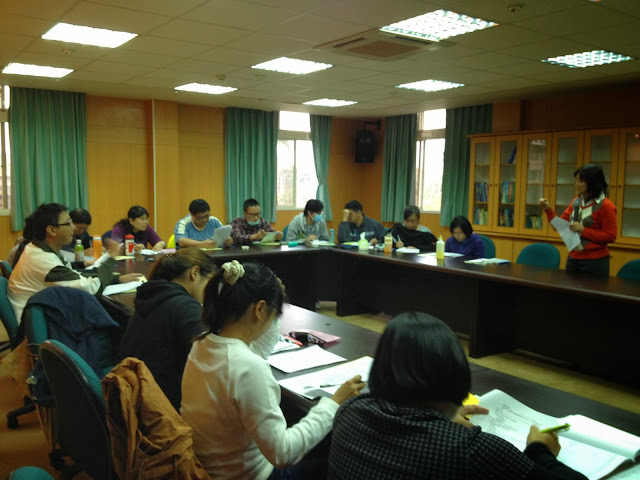
Graduate students from NTU OT program attended the MOHO class and shared their experiences

Image

Undergraduate students from NTU OT visited MOHO center in May 28, 2015

Image

Scholars from abroad visited our center in 2014

Image
Scholars from OT of Japan and University of Illinois, Urbana Champaign visited our center

New research findings of MOHO in Taiwan

Title : The Effectiveness of Remotivation Protocol for Persons with Schizophrenia Author : Sheng-Hui Wang Thesis Advisor : Ay-Woan Pan Major findings : The results from this study show that utilization of a remotivation protocol helps to increase the patient's volitional performance, increase motivation to participate in occupational performance, and improves negative symptoms. Participants :         *N=10         *7 males, 3 females         *Age: 42 + 11.52 (range: 23-56)         *Diagnosis: Schizophrenia         *Setting: Inpatient acute ward in a psychiatric institute         *Ethnicity: Asian (Taiwan) Methods : The researchers translated the English edition of the remotivation process manual into Mandarin. In order to ensure the Mandarin versi...

Sophomore OT students of NTU visit MOHO center in Taiwan

Image

International students from Finland and USA are taking the MOHO class at NTU

Image

Finnish student exchanged to Occupational Therapy Department of National Taiwan University in Spring semester of 2014, who takes the MOHO course with Dr. Ay-Woan Pan

Image

Dr. Ay-Woan Pan teaches MOHO instruments to OT in mental illness institute in Yu-Li

Image
Dr. Pan teaches Volitional Questionnaire and Assessment of Interaction and communication skills to OT in Yu-Li branch of Taipei Veterans General Hospital on Nov 18, 2013

Visitors from the department of occupational therapy of Yu-Li branch of Taipei Veterans General Hospital

Image
Welcome the OTs from Yu-Li branch of Taipei Veterans General Hospital (11/11/2013)       

MOHO course in school of OT at NTU-2013

Image

Learning MOHO in Taiwan

Image
Two students from Finland (JAMK University of Applied Science) come to MOHO center in Taiwan at School of Occupational Therapy at National Taiwan University to MOHO in Sep  2013 

MOHO center in Taiwan

Image
The exchange student from University of Applied Science of JAMK learned MOHO in School of OT at National Taiwan University (MOHO center in Taiwan) (May 3, 2013)  

Pediatric Volitional Questionnaire-Published in Journal of Rehabilitation Medicine (2013)

Reliability and Validity of the Paediatric Volitional Questionnaire- Chinese Version Liu, L.T., Pan, A.W., Chung, L., Gau, S.S.F., Kramer, J., & Lai, J.S. Abstract Objective: The purpose of this study is to examine the psychometric properties of the Chinese version of the Paediatric Volitional Questionnaire (PVQ-C) for use amongst preschoolers in Taiwan. Methods: Forty preschoolers with developmental delays were randomly selected from northern Taiwan, along with another 40 typically developing preschoolers. The data was analysed using Rasch measurement model for construct validity and classical test theory for item reliability, intra- and inter-rater reliability, and convergent validity. Results: The results indicated the PVQ items of PVQ-C fit into a unidimensional continuum of volition (logit –6.63~3.05) with 2 items representing differential item functioning for diagnostic group. The person-fit statistics showed that 83% participants’ response could be appropriatel...

The visitors from Mainland China on Feb. 22-24, 2012

Image
The visitors from the Wuxi mental health center of Mainland China came to our center to learn MOHO on Feb. of 2012.

Sharing the MOHO workshop live on Feb. 18, 2012

Image
      A capacity crowd at the workshop. The audiences are attentively learning in the class. Dr, Ay-Woan Pan is teaching the MOHO concept and related assessments to audience. A group photo for the spekers and audiences.